Showing posts with label confuzie. Show all posts

Sunday, 5 February 2017

Diferenta dintre "well done" si "Good job"


"Well done" si "Good job" ambele sunt termeni de încurajare sau de felicitare, nu există nici o diferență de sens; cu excepția faptului că "well done" este mai formal decât "good job".

Diferenta dintre "feel good" si "feel well"

"Feel good" = feel happy, confident
Ex.: She felt so good at the party that she danced all night.
        Ea s-a simtit asa de fericita la petrecere ca a dansat toata noaptea.

"Feel well" = feel healthy  ( se refera la sanatate)
Ex.: He has cough but he feels well.
        El tuseste, dar se simte sanatos.


Aceasi regula este si cu  "look good" si "look well".
"look good" - se refera la infatisare ca arati bine
Ex.: Anna is looking good with that make up.
        Ana arata bine/frumos cu acel machiaj.
"look well" - se refera la starea de sanatate
Ex.: I got cold but I look well.
        Eu am racit, dar arat sanatos (nu arata bolnav).

Cand se foloseste " good" si "well"

"Good" = bun
"Good" este un adjectiv si raspunde la intrebarea " ce fel de".


"well" = bine
"Well" este un adverb si urmeaza un verb de actiune,raspunzand la intrebarea "cum"


Diferenta dintre " Sometimes, Some time, Sometimes "


"sometimes" = ocazional, uneori
Acesta este un adverb de frecventa si poate fi inlocuit cu "now and then" sau " at times", fiind sinonime.
Ex.: Sometimes I wake up very tired.
       Uneori ma trezesc foarte obosita.


"sometime" = candva 
Acesta este un adverb folosit sa se vorbeasca despre un nespecific timp,in  trecut sau viitor.
Ex.: We should get together for coffee sometime !
        Ar trebuie sa ne intalnim candva sa beam o cafea !


"some time" = ceva timp (o perioada de timp)
Ex.: She has some time to watch TV.
       Ea are ceva timp sa se uite la televizor.

Friday, 20 January 2017

Diferenta dintre cuvintele "someone" and "somebody"

In cele mai multe situatii, acestea sunt interschimbabile. Singura diferenta in care cei mai mulți vorbitori nativi pot fi de acord asupra acestei diferente, este ca "someone" este mai formal decat "somebody" (la fel ca "anyone" este mai formal decat "anybody", si "everyone" este mai formal decat "everybody" )


everyone, everybody = toti
anyone, anybody = oricine
someone, somebody = cineva, careva


"BETWEEN" versus "AMONG"


Wednesday, 18 January 2017

In ce context folosim "when" si "while"

NOTA: "while" sau  "when" sunt folosite cand o actiune continua lunga este intrerupta de o scurta actiune.


                                            Exemplu 1
While I was doing my homework, my mother knocked at the door. = In timp ce faceam temele, mama                                                                                                                a batut la usa.
I was doing my homework, when my mother knocked at the door.  = Imi faceam temele cand mama
                                                                                                               a batut la usa.

                                             Exemplu 2
While I was doing my homework,the telephone rang. = In timp ce faceam temele, telefonul a sunat.
When the telephone rang , I was doing my homework. = Cand telefonul a sunat,imi faceam temele.                                                                                                        
                rang - second form of the verb


                                                                                          WHEN                                                                                          
                                                                                           cand


"When" este folosit :
                                - sa exprime o actiune intamplata in cadrul altei actiuni;

                                - sau folosit sa exprime o actiune care s-a intamplat imediat dupa alta actiune.


"When" de cele mai multe ori este folosit cu timpul trecut simplu si se refera de obicei la etape ale vietii,secole,vechime.


                                           Exemplu:
I was eighteen when I got my driving license.= Am avut 18 ani cand am luat permisul de conducere.


                                                                                              WHILE                                                                                          
                                                                                            in timp ce 


"While" este folosit sa exprime doua actiuni continue intamplate in acelasi timp si exprima idea de "during that time" = " in acel timp"

"While" este de obicei urmat de timpul trecut continuu.


                                         Exemplu:
He slept while I was cooking supper. = El a dormit in timp ce eu am gateam cina.


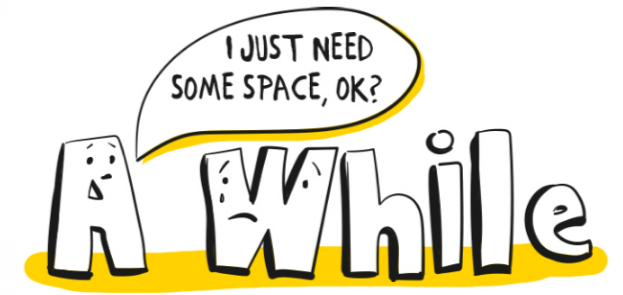
Diferenta dintre "while" si "a while"


Sa vedem in lectia de azi diferenta dintre "while" si "a while"; se scriu la fel , dar unul dintre ele este despartit de litera "a" .
Acesti doi termeni reprezinta diferite parti de vorbire.


                                                                                              awhile                                                                                      
                                                                     pentru putin timp, pentru un timp

"Awhile" este un adverb si nu poate fi folosit dupa o prepozitie.


                             Exemplu:

I waited awhile,then I rang again. = Am asteptat o vreme., apoi am sunat din nou.


                                                                                       a while                                                                                              
                                                       o perioada de timp, un interval de timp

"A while" este un substantiv ,constand din articolul "a " , si poate fi folosit (de cele mai multe ori este folosit) dupa o prepozitie; mai frecvent dupa prepozitile:"for" ,"after" sau "in".

                        
                         Exemplu:

I was dead for a while before the prince showed up. = Am fost mort pentru o vreme inainte ca printul                                                                                        sa se ridice/scoale.


                                                                          SUMAR


Diferenta dintre adverbele during, for si since


       In lectia de azi ,voi scrie despre adverbele  "during", "since" si "for"- adverbe de timp si bineinteles ne indica timpul.

       La sfarsitul lectiei veti vedea prin exemple ca "since" si "for" pot lua si alte parti de vorbire.


 DURING                                                                                               
                                                           during = in timpul, pe parcursul, in (de)cursul

Adverbul "during" este folosit inaintea unui substantiv sa spui cand ceva s-a intamplat; acest adverb nu ne spune cat timp s-a intamplat.


                               Exemple:

During my trip to Japan, I learned that is it polite to make noise when you eat.= In timpul calatoriei mele in Japonia, am invatat ca este politicos sa faci zgomot atunci cand mananci.


                                                                                           FOR                                                                                                          
                                                                                  for = pentru, de 

Adverbul "for" este folosit pentru a arata de cat timp dureaza ceva
Acest adverb poate fi folosit cu toate timpurile.


for+period of time 
     +number and time word


                                  Exemple:


 I have known her for a long time. (Correct)   = Am cunoscut-o pentru o lunga perioada de timp.  
                                                 I know her for a long time. (Incorrect) = O cunosc de mult timp.


I was there all day. (Correct) = Am fost acolo toata ziua.
I was there for all day. (Incorrect) = Am fost acolo pentru toata ziua.


                                                                                         SINCE                                                                                                    
                                                                       since = de cand, de atunci 

       Adverbul "since" precizeaza inceputul unei perioade de timp; cand ceva a inceput in trecut si continua pana acum.
       Acest adverb este de cele mai multe ori folosit in prezentul perfect si prezentul perfect progresiv.

since +  starting point
         + a time / a date 

                                  
                                  Exemple:


have been here since 5 o'clock and I am getting tired. = Am fost aici de la ora 5 si devin obosit.

I had been working since 5 o'clock and I was getting tired.= Am fost de lucru de la ora 5 si am devenit obosit.


                                                                       FOR vs. SINCE


                           FOR                       SINCE 
I have been a doctor for fifteen years. (duration = 15 years)

Am fost medic timp de 15 ani.(durata=15ani)
I have been a doctor since 1992. (starting point = 1992)

Am fost medic din 1992 ( punctul de pornire =1992)


We have been married for 14 year.
Am fost casatoriti timp de 14 ani.
We have been married since 2001.
Ne-am casatorit din 2001.


Ambele adverbe "for" si "since" au si alte semnificatii, fara referire la timp.


                                  Exemple:

 - This is for you.  = Este pentru dumneavoastra.
 
  - Is this the train for London? = Este acest tren pentru Londra?

 - Since you ask, I'll say yes. = Din moment ce va intreb, voi spune da.

 - Since he didn't study, he didn't pass the exam. = Din moment ce el nu a studiat, el nu a trecut examenul.

Tuesday, 17 January 2017

Verbele neregulate Lie si lay

"LIE" si  "LAY" ambele au multe definitii,dar acestea sunt cel mai adesea confundate.
Problema este ca, atunci cand vorbim, noi frecvent le folosim gresit.
Ca un rezultat, urechile noastre sunt folosite sa asculte formulari incorecte.

           Distinctia este simpla :
 - "lay" are nevoie de un obiect-ceva fiind disponibilizat;.
 - "lie" nu poate avea un obiect 


                                                                                  LIE                                                                                                          
                                                             lie = a se odihni, a se propti  
                                                                  = a se pune orizontal pe o suprafata


                                                                                        LAY                                                                                                            
                                                               lay = a aseza/a pune ceva pe ceva)